
Aglow - Part II
“Do you know about integrity?”

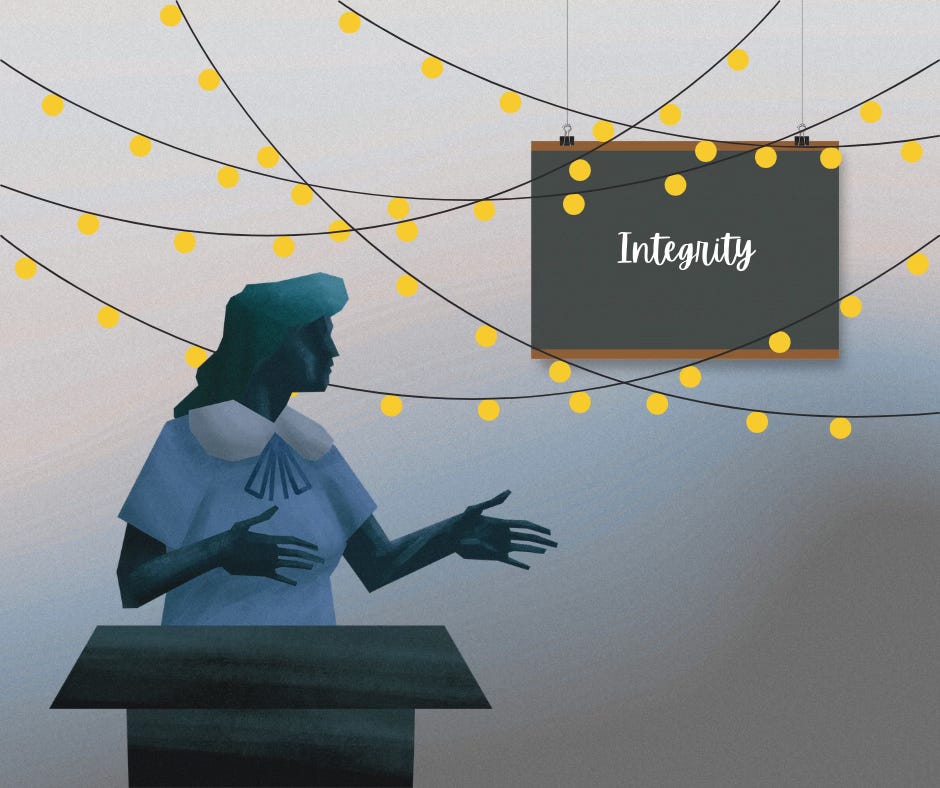
During my walk, a sudden burst of rain fell from the sky. I was not too far away so I rushed towards the building and up the cemented staircase that formed the entrance. Inside the building, a wave of warmth hit me, a contrast to the cool freshness of the air that had mingled all day with rain. The yellow ceiling lights cast a warm glow over the lobby where, at the edge, was a table where the librarians had placed their recommended books for the month. While I always browsed through these, I hadn’t had time this month, and as I headed to the door for the stairs, the book covers were a blur of mixed colors.
But I knew where I was headed— the third floor which contained all the political science books. From the moment I’d discovered this space as a first year student, I’d spent countless hours in this corner of the library. Rows and rows of books— about the history, policies, governance, power changes across the world. It promised me a journey across time and space through the eyes of multiple statesmen, policymakers, bureaucrats and academics whose goal was to address— in their own ways— the workings of a nation. This corner of the library was my social space, where I was the chief communication officer, who connected the threads between ideas separated by time, geography or language.
That day, as I walked through the shelves, I felt an eerie silence ring through the library. I had been worried that I might not find any study spaces— for finals were approaching— but it appeared, once I reached the desks, that my worries were futile. The entire room was empty.
Quickly, I claimed my favorite desk— it was closest to the books and also by the large glass windows which acted as the building’s exterior. Outside, the rain had intensified— although sound couldn’t penetrate the glass exterior, the large raindrops fell in a rhythm. Lines of water streaked the glass.
I removed the study materials from my bag and placed them— neatly— in the desk. The heaps of readings arranged right next to the laptop, which I hadn’t opened yet. Next to it were a notebook and a pen. The scene was set— I was ready to study. Yet, I felt a powerful reluctance when it actually came down to opening my books and studying.
I put down my head on the table facing the word of bookshelves. On other days, when I’d need a break from my studies— I would walk through the shelves which had transformed the vacant room into an endless walking trail. As I walked through the shelves, I would feel like I was on an adventure— the bookshelves hiding me from the rest of the world. At every turn, I was certain to find a new book to interest me. I usually followed these trails with headphones on and upbeat pop music blaring from them. Despite the dark hues of blue, green, brown and black of the spines of the academic tomes, I always felt illuminated as I walked. Perhaps it was the familiarity with the books’ authors and ideas that brought me so much comfort.
I got up from the desk and walked towards the shelves. A melancholy had settled inside me and I did not feel like putting on any music today. The quiet felt unsettling. Even though the volumes had been my comfort for so long— today they felt aloof. As I gazed through the titles, each of which I had spent hours with, they all felt like a blur.
Maybe I should call my mother…
As I reached for my phone, I remembered that it was past midnight for her due to the time difference. I didn’t want to disturb her at this hour.
I retreated to the trails of the bookshelves even though they couldn’t soothe my agitation today. Why did I feel so agitated today anyways?
It had all started when I had heard about the change in the government. But the political instability in my country was not novel. Yet, it had never bothered me so much before.
Perhaps it was because I’d be graduating soon. The jobs that I had only studied about so far— now I’d have to strive to attain them.
I walked back to my desk— where at the top was the first draft of my senior thesis about Good Governance. I had created a comprehensive thesis synthesizing and evaluating components across multiple countries and continents— from lack of corruption to establishment of public services and infrastructure to elements of check and balance across state institutions. I was sure that when I started my career in politics— I’d have the visionary ideas to lead whatever sector I was in charge of.
I had believed in my education and learning so much that it never occurred to me that there might be barriers stopping me from getting the job I wanted.
How could I have been so naive?
I had embroiled myself so deeply in learning the mechanics of how everything occurred— the problems and challenges of the nation’s development— that I’d never visualized myself amongst those politicians— navigating the challenges of their shifting interests which did not align with the interests of my nation. In my naïveté, I had believed that others would value my knowledge and anoint me into the positions which would allow me to do the work I wanted to do to develop the nation.
Had I made a folly— throwing away my life so far to pursue a childhood fascination?
Perhaps I should have chosen a profession that aligned more with my quiet, focused personality— perhaps an account or a librarian or a software engineer. If I’d set my heart and mind upon this profession at age 10, who’s to say that I wouldn’t have enjoyed it equally?
As I walked through the shelves, the letters on the spine of the books evaporated— they were no longer visible to me. The discrete volumes— each of whose pages I had sifted through carefully— reading each word, deciphering each sentence— became indistinguishable. They became like solid walls through which I was walking. While I perceived these changes around me— and felt displaced from a place that had once been so familiar— it became just another factor to escalate my internal turmoil.
Now, along with the doubts and uncertainty about my future— fear mingled in. A shudder rushed through my body. Why was this news impacting me so? What exactly was I afraid of?
At that moment, my mind flashed back to an afternoon from my childhood.
It was an autumn afternoon. I remember because it was right at the cusp of the Dasain festival’s main day. My vacation had started seven days ago and within the week, I had finished all my homework. The house was quiet— my father had gone to the market and my mother was in her room— probably working on her writing. Her latest work was a poetry collection, but the theme was a secret for now. She’d tell us after she was done.
The bright, autumn sun spilled into my room and the soothing, cool air seeped in from the netted window. I was sitting in the couch, reading a novel about a dystopian society with a tyrannical government. Just as I was reading about the plan that the protagonists had conceived to thwart the government, my mother walked into the room. She was still dressed in her loose-fitting, mauve nightgown. She had probably gotten started writing as soon as she had woken up. I hadn’t even seen her during lunch time when my father and I had dined together, sitting across from each other, eating the hot meal of rice, spinach and paneer that he’d made specially for me because those were my favorite.
“Where’s Ama?” I had asked.
“She’s working. Besides, she said she wasn’t hungry right now. She’ll eat later.” He had replied.
As my mother sat opposite before me now, I wondered if she had eaten. But I didn’t ask. There were days she’d sometimes go without eating because she’d be so immersed in her work. And then, she’d faint because of weakness. But my father always knew how to revive her.
She was playing with her plaited hair when she said, “ How’s your dreams of being the Prime Minister going?”
I was surprised because she’d never asked me before. It was common knowledge in our household that I wanted to become the Prime Minister. But I never discussed it with my mother.
I had heard— sometimes through my mother’s reminisces about her past but mostly through prodding my father with questions— that my mother had once wanted to become the prime minister herself. But she didn’t speak much about it and when I asked, my father always spoke reluctantly. I didn’t know fully why my mother did not like to speak much about it. It felt as though my own mother was a mystery, and I, a seeker, who occasionally succeeded to gather wisps of information about her.
“I’m just in seventh grade now,” I said, meekly. “But I am doing my best in my studies. That should get me somewhere,” I said, more confidently.
My mother smiled. She was quiet for a moment.
“Do you know about integrity?” She said, in a reflective voice, her eyes not looking at me, as though she was somewhere else.
I knew the word— vaguely though— but I couldn’t remember the meaning exactly. But before I could reply— my mother was gone from the room.
My mother wasn’t around much when I was younger— she was mostly locked up in her room—writing. It was after I got into college, at 18, that she started paying more attention to me. Perhaps, she had taken me for granted when I was with her, in the same house. But the prospect of being thousands of miles away— that had shaken her somehow.
Yet, over all these years, Integrity— that was the one word I had learned from the woman who birthed me. As I grew up— that became the one value that I absorbed to my core.
Part 3: Coming on 20 March 2026
Integrity is so relevant in today. Appreciate that you hav written a story about its value.